CS Leadership & Team Building
CS OperationsCS Leadership & Team Building
Cleaning up for the new year: CS Ops Edition
November 12, 2025·4 min read
 Linnea Olson
Prevent Q1 customer success chaos before it starts. Discover 3 operational deep cleans—data audits, automation reviews, playbook standardization—that top CS teams execute during the holiday break.
Why the Holiday Lull is Your Secret Weapon Against Q1 Chaos
It’s the most wonderful time of the year. Not for carols or hot cocoa, but for deep, uninterrupted operational work, I love working with CSMs but this uninterrupted time is my favorite because even though it seems like a lot of busy work its incredibly impactful for your users.
Right now, your CSMs are either hustling to squeeze in those final QBRs or starting to check out, mentally calculating how many days they can get away with wearing sweatpants, while keeping customers happy enough through the holiday season.
For the CS Ops leader, this is not downtime. This is a gift. This is your strategic window—the one time of year when you aren't fielding frantic Slack messages about broken automation or emergency reporting requests.
This is the moment to tackle the strategic debt and data hygiene issues that have been slowly accumulating like technical debt all year long. This is how you avoid the Q1 panic.
Here are the three foundational "deep cleans" that top CS Ops should be planning to execute, leading your organization to a scalable, efficient, and profitable new year.
1. The Great Data Purge: Auditing Your Health Score and Inputs
If the phrase “Garbage In, Garbage Out” doesn't make you instantly shudder, you might not be in CS Ops. Everything you do—from automation triggers to forecasting—relies on clean, reliable customer data. And if you haven't looked under the hood of your Customer Health Score in a few quarters, it's probably running on fumes.
The Action Plan:
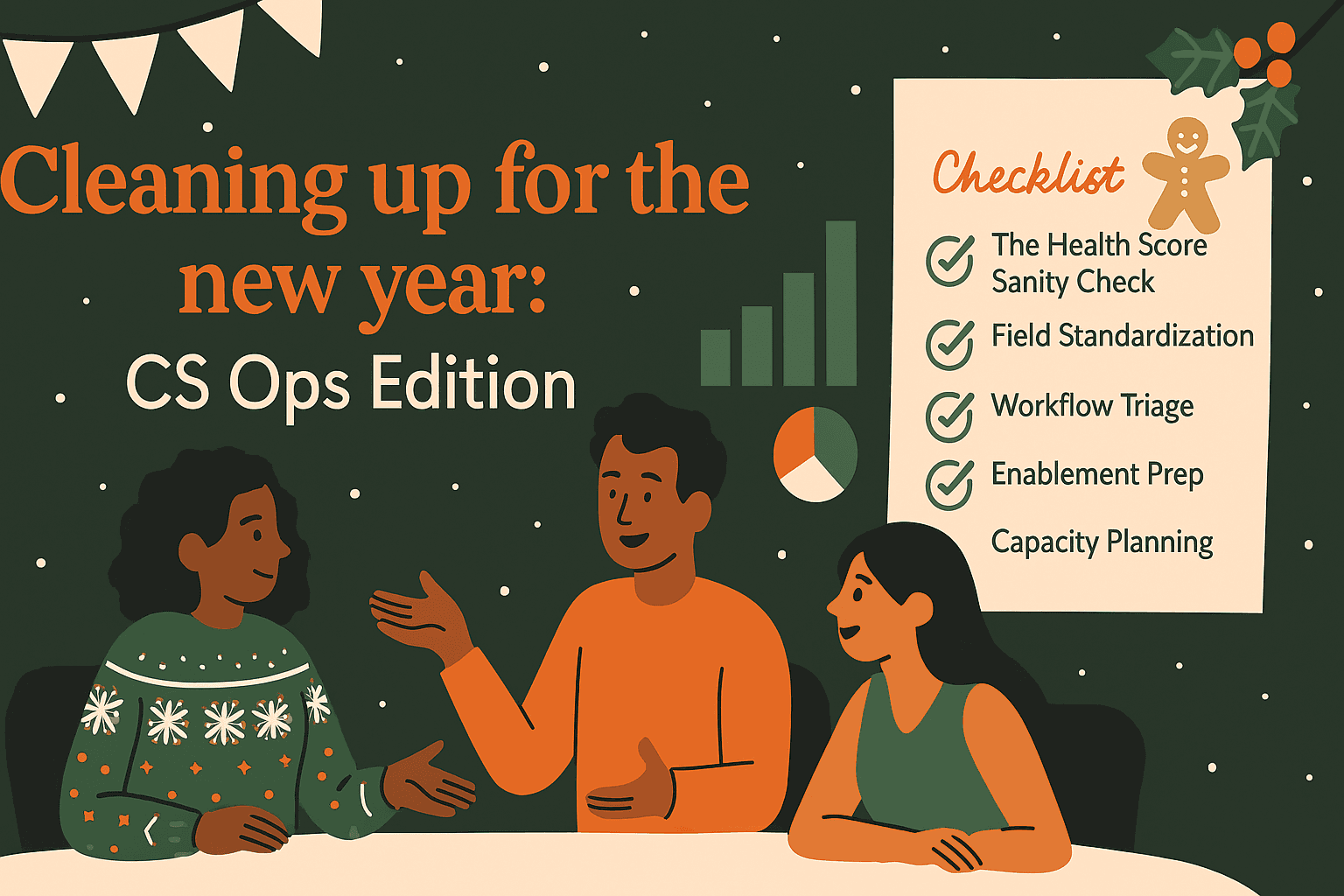
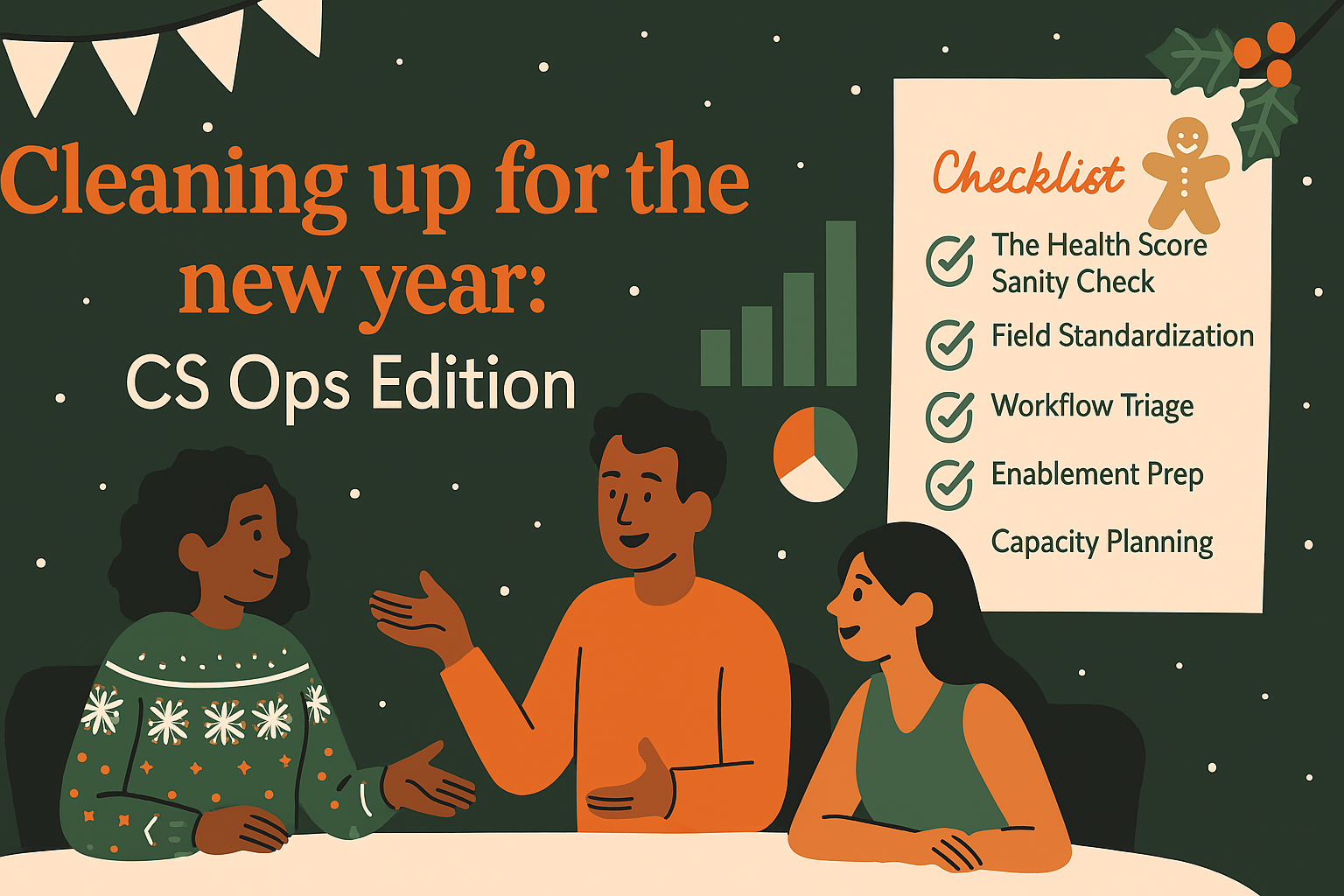
The Health Score Sanity Check: Did your high-risk score accurately predict the customers who churned this year? If a customer who looked "green" on paper still left you, your health score is broken. Use this quiet time to analyze this year’s loss drivers and recalibrate your scoring logic. CS Ops Best Practice: Incorporate signals from non-CS systems. Talk to Finance about payment delays and Product about deep feature abandonment, then use that cross-functional data to create a new, more robust scoring model.
Mandate Field Standardization: Go through your key customer objects (Account, Contact, Opportunity). Identify required fields that are riddled with bad or dummy data. Fix formatting issues and standardize picklists. You can build new workflow rules (or train your system to prevent "bad data entry") for Q1, but first, you have to clean up the mess you’ve got.
Systemic Duplication Culling: Duplicate accounts and contacts aren't just an annoyance; they directly corrupt ARR reporting and customer segmentation. Run reports to identify duplicates and merge/archive records. Don't just fix the data; fix the source, whether it's an integration or a sloppy process handoff from Sales Ops.
2. The Tool Sprawl Smackdown: Tech Stack & Automation Audit
All CS leaders dread their budget review cycle, work now to make these conversations easier on everyone and help reduce “Tool Sprawl.” As teams scale, every CSM team seems to acquire a new, specific piece of software, leading to redundant systems, overlapping functionalities, and—worst of all—confusing workflows.
The holiday season is your chance to measure your tech stack's actual ROI, not just its advertised potential.
The Action Plan:
Workflow Triage: Pull a report of all automated workflows (in your CSP, CRM, or automation platform). When was the last time they ran successfully? Are they still relevant? Kill every automation that was built for a legacy product line, a pilot project, or a process that has since been simplified. If an automation saves 5 minutes a day but hasn't run in six months, it’s a liability. Don’t forget to document as you go, your future self with thank you as you get asked questions or need to fix something.
The Unused Seat Reckoning: Conduct a thorough audit of user accounts across your software platforms. Deactivate all former employee accounts and revoke unnecessary access permissions. This is an easy way to eliminate a recurring line item from your Q1 budget and improve hygiene.
Survey for Friction (Internal Audit): Run a quick, anonymous survey to your CSMs. Ask them:
"What tool creates the most friction in your day-to-day work?"
"What is one feature of [Primary CS Tool] you never use?"
Why? The answer will justify simplification, new enablement plans, or even a tool replacement in the coming year.
3. The Playbook Polish: Standardization and Future-Proofing
The Customer Journey is mapped, the core processes are documented... maybe. But when was the last time your renewal playbook reflected your current year’s actual learning?
The difference between a growing CS team and a stagnant one is standardized processes. Use this time to standardize the playbooks that actually win and document the tribal knowledge that only your top performers possess.
The Action Plan:
Standardize the "Win" Playbooks: Review the processes around your biggest successes this year—high-value expansions, major advocacy moments, or fastest time-to-value cohorts. Document these best practices into repeatable, standardized playbooks for Q1. CS Ops Best Practice: Look for opportunities to turn a reactive playbook (e.g., "Customer Risk Alert") into a proactive one ("Customer Success Momentum Checklist").
Q1 Enablement Prep: Based on the data purge and tech stack audit, update all your team training and enablement materials. No CSM should walk into January with documentation that refers to an automation you just killed or a health score that’s no longer in use. Prepare your bite-sized training modules now so you can roll them out during the first week back.
Capacity Planning Alignment: The quiet time is your chance to run "what-if" scenarios for the year ahead. Review your metrics like Annual Recurring Revenue per CSM and Accounts per CSM. Based on the hiring plan for Q1, model the optimal book of business structure. You need to be ready to tell leadership exactly what the team capacity looks like when they drop the new hiring plan on your desk in January.
End the Year Smart, Start the Next Year Strong
The holiday break isn't just about eggnog; it's about giving yourself a head start. While everyone else is nursing a food coma, you're building a foundation that will prevent chaos from becoming the theme of your Q1.
Get to work. The rest of the year depends on it.